





What Is Swinging? A Complete Guide to the Swinging Lifestyle for Couples and Singles
What swinging is, how it differs from other open relationships, and how couples and singles get started in the lifestyle.
By Nico Pierce, SDC Media Content Manager
Reviewed by Lexi Sylver, SDC Media Director, and internationally accredited open lifestyle, relationships, and life coach
Updated November 2nd, 2026
Swinging, the best-known branch of what the community calls "The Lifestyle," is the most social way couples explore sex beyond monogamy and one of the most misunderstood. Look past the retro stereotypes and the key-party jokes and you'll find something refreshingly down to earth: happy couples who've decided, together, that sex with other people is something they'd rather share than hide.
So what is swinging, exactly? Swinging is a form of consensual non-monogamy in which a committed couple agrees to have sexual experiences with other people, together or separately, without pursuing romantic relationships outside the couple. It rests on two principles: both partners know and agree, and both partners set the rules together.
There's no single correct way to swing, and that's a big part of the appeal. Some couples keep it to flirting at a party, while others build long-term friendships with couples they've come to trust.
The experts at SDC.com answer your biggest questions below, from how to get started in The Lifestyle, where to meet people, how etiquette works, and how to stay safe.
Key Takeaways
• Swinging is a form of consensual non-monogamy in which a committed couple has sexual experiences with other people, together or separately, with each other's full knowledge and agreement.
• It's sexual, not romantic. That's the line between swinging and polyamory or an open relationship.
• Both partners play. That's the line between swinging and hotwifing or cuckolding, where one partner plays and the other watches.
• Soft swap vs. full swap. Soft swap means everything short of intercourse with someone new, while full swap includes it. Many couples start soft and stay there.
• Swinging isn't cheating. Everyone involved knows and agrees, and the couple sets the rules together.
• Consent is enthusiastic and revocable at any moment. "No" needs no explanation, and nobody at a party owes anyone anything.
• Swingers meet through lifestyle dating platforms, swingers clubs and house parties, hotel takeovers, and lifestyle travel.
• What usually goes wrong is moving too fast, or one partner going along to please the other. Both are avoidable with preparation, and both are recoverable.
What Is Swinging?
Swinging is a form of ethical non-monogamy in which committed partners agree to explore sexual encounters with other singles or couples while keeping their emotional and romantic bond reserved for each other. Unlike some other open relationship styles, which can include romantic connections, swinging is primarily about sexual exploration and shared pleasure.
Swingers may swap partners with another couple, invite singles into their play, explore group play or simply flirt and watch, often in safe, social settings like swinger clubs and private parties.
Where Does the Word "Swinger" Come From?
"Swinger" comes from 1960s American slang, where "to swing" meant to be free and uninhibited, and by the middle of the decade a swinger was someone who took that freedom into their sex life. Before that, the press called the practice "wife swapping," a 1950s phrase that still turns up in search bars today. The Lifestyle dropped it decades ago because it treats a wife as property being traded and leaves out the fact that she chose it.
"The Lifestyle" came from inside the community. Swing-club organizers adopted it in the 1970s as a discreet label (the group behind the first big lifestyle conventions called itself the Lifestyles Organization), and it stuck because you can ask whether someone is "in the lifestyle" without saying anything explicit. The old code question "Are you a friend of Ellis?" (L.S., for lifestyle) did the same job in the days before profiles.
When Did Swinging Start?
Swinging took off as a recognizable scene in the United States in the 1960s, riding the sexual revolution. The key party, with car keys tossed into a bowl and a random ride home, is the era's most repeated image, and the 1969 film Bob & Carol & Ted & Alice put partner swapping in mainstream cinemas. The 1970s brought the first dedicated clubs and conventions before the 1980s cooled the scene. The internet revived it in the 1990s, and since SDC launched in 1999, lifestyle couples and singles have been finding each other online.
The often-repeated story that swinging began among Air Force pilots and their wives in the 1940s has never been documented, and it's best treated as folklore.
Is "The Lifestyle" the Same as Swinging?
Not exactly: "The Lifestyle" started as swingers' own discreet name for what they do, and today it's the umbrella term for the wider open community, with swinging as one specific practice inside it. As the community grew to include kink and other forms of open relationships, the label grew with it, while swinging kept its original meaning: a couple playing with other people, sexually rather than romantically.
That's why the two words get used interchangeably, and why they aren't quite the same thing. Every swinger is "in the lifestyle," but not everyone in the lifestyle swings. Some are in open relationships, some are polyamorous, some are hotwifing couples, and plenty come for the parties and the people.
The words you'll see: a swinger is the person, swinging is what they do, the swingers lifestyle is the community around it, and "The Lifestyle" is its everyday shorthand. "Swingers" and "swinger" both turn up in searches and both are correct. "Wife swapping" and "partner swapping" are older or outside names for full swap, and people outside the lifestyle altogether are "vanilla," which is a description, not an insult.
One more thing that trips people up: "open" and "swinger" aren't rivals. Many swingers describe themselves as open, and some open couples swing occasionally without ever using the word. Labels matter less than knowing what you want.
Who Can Be a Swinger?
Anyone who's sexually open-minded and interested in consensual exploration can be a swinger, regardless of sexual orientation or gender identity. Besides swinger couples, you'll find single women (sometimes called "unicorns") and single men (usually listed as "single males" or "SM" on profiles and party invitations) who enjoy connecting with couples or other singles.
"Bull" is a hotwifing and cuckolding word for the man who plays with one partner while the other watches. Single men in the swinging lifestyle have their own etiquette to learn. Some people are newer to the lifestyle and curious to learn, while others are experienced and looking for deeper connections or new adventures.
What's the Difference Between Swinging and Other Relationship Styles?
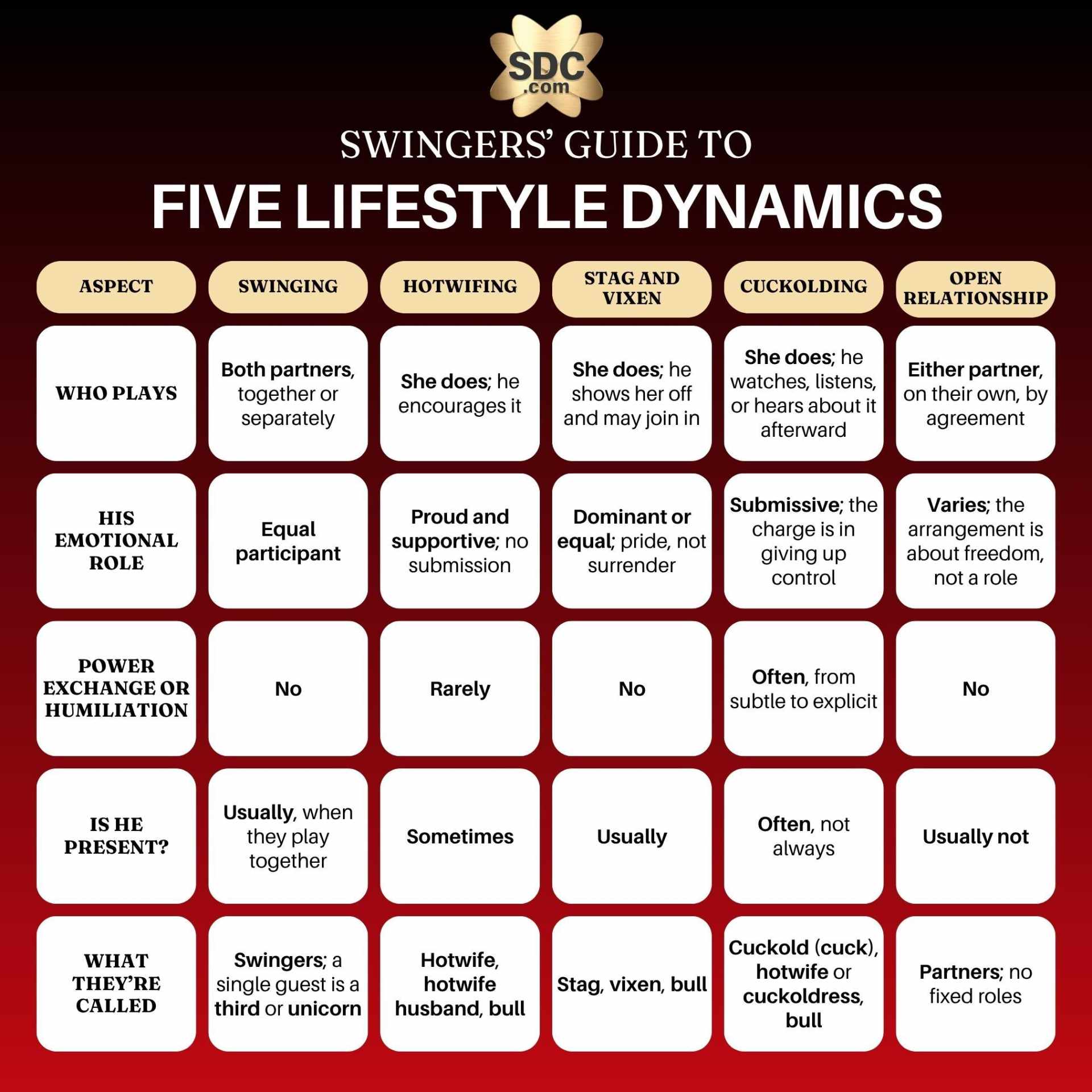
Swinging is the only common open relationship style in which both partners play and neither pursues romance outside the couple. That one sentence separates it from everything it gets confused with: open relationships (broader), polyamory (romantic), hotwifing (one partner plays), and cuckolding (one partner plays, with a power exchange). Here's each comparison in turn, with a table at the end.
Swinging vs. Open Relationships
"Open relationship" is an umbrella term for relationship styles where partners consent to sexual or romantic experiences outside their primary relationship, including swinging, polyamory, hotwifing and cuckolding, among others.
Swinging is a structured, couple-centered open relationship style focused on shared sexual experiences rather than emotional entanglements outside the couple, and that focus is the clearest dividing line when you compare swinging vs. polyamory vs. other open relationships.
Swinging vs. Hotwifing
Swinging typically involves mutual play, with both partners exploring with others, often together. Encounters are social and sexual, and they usually don't include power dynamics.
Hotwifing centers on the wife or girlfriend having sex with others, often with her partner arranging it and enjoying the aftermath, whether he watches or hears about it later. Hotwifing occasionally plays with voyeurism and exhibitionism, and stag/vixen power dynamics. The male version of hotwifing is called "hot husbandry."
Who gets to play is the real dividing line in swinging vs. hotwifing: in swinging, both partners are players, while in hotwifing, she plays and he gets his thrill from encouraging her.
Swinging vs. Cuckolding
In swinging, both partners play, and the purpose is mutual physical enjoyment.
In cuckolding, the husband (the "cuck") watches his wife (the "cuckoldress") with another man (often known as a "bull"), usually with an erotic element of submission or humiliation at play. That deliberate imbalance is what defines the cuckold lifestyle: one partner plays while the other gets his thrill from giving up control.
Cuckqueaning is the female version of cuckolding, where the female partner (the "cuckquean") watches her male partner have sex with another woman, sometimes with the same psychological kink elements involved.
Swinging vs. Polyamory
Swinging typically means there's no romantic entanglement with anyone other than your primary partner, and the emphasis is on exploring others through sexual play.
Polyamory is a type of open relationship that involves emotional and romantic relationships with multiple people.
Here's how the five dynamics compare side by side:
Why Do Couples Choose Swinging?
Couples choose swinging for four main reasons: sexual variety inside a committed relationship, fantasies that take more than two people, the closeness that comes from planning it together, and a safe outlet for voyeurism or exhibitionism. Most couples feel some mix of these, and the reasons couples start swinging may shift once they're in the lifestyle.
Does Swinging Add Sexual Variety to a Long-Term Relationship?
Yes, for many couples swinging brings fresh excitement into a long-term relationship without either partner having to look outside it in secret. Novelty is one of the strongest drivers of desire, and seeing your partner wanted by someone new can reignite an attraction that routine had quietly dimmed. Plenty of couples say the best part of the night is the ride home together.
What Fantasies Can Couples Explore Through Swinging?
Swinging lets couples explore fantasies that are difficult or impossible for one partner to fulfill alone, such as threesomes, group play, bisexual experiences or same-room play with another couple. Exploring them in the lifestyle means you do it side by side with agreed-upon boundaries, instead of leaving them as private what-ifs.
Can Swinging Bring Couples Closer?
Yes, swinging can deepen emotional intimacy because it asks partners to communicate openly and keep checking in with each other. Planning a night together and debriefing afterward builds a level of honesty many couples never reach in monogamy, and that openness tends to carry over into the rest of the relationship.
Why Do Voyeurs and Exhibitionists Enjoy Swinging?
Swinging gives voyeurs and exhibitionists a safe, consensual outlet, because lifestyle clubs and private parties are built for watching and being watched, with everyone there by choice. Whether you love the view or love being the view, the lifestyle gives both desires a setting where consent comes first.
How Common Is Swinging?
Swinging is far more common than its reputation suggests, and 12% of U.S. adults say they've had sex outside their relationship with their partner's consent, according to a February 2023 YouGov poll of 1,000 U.S. adults. The same poll found that one-third of Americans (34%) describe their ideal relationship as something other than complete monogamy.
A 2021 study in Frontiers in Psychology, based on a national sample of more than 3,400 single Americans, found that about one in nine have been in a polyamorous relationship and one in six would like to try one. No national survey counts swingers on their own, so these numbers cover consensual non-monogamy as a whole, but they're the closest measures available.
How Many People Fantasize About Swinging?
A threesome is the single most popular sexual fantasy in America, according to Dr. Justin Lehmiller's survey of 4,175 Americans for his book Tell Me What You Want. It was also, in his words, the fantasy "least likely to turn out well when people acted on it." That's an argument for preparation, not against the fantasy, and it's exactly why communication and boundaries matter before anyone plays.
Do Consensually Non-Monogamous Relationships Hold Up?
Most recent research says they do, and a 2025 meta-analysis in The Journal of Sex Research found that people in consensually non-monogamous relationships are just as satisfied as monogamous couples. The analysis pooled 35 studies covering roughly 24,000 participants. Individual studies still vary, and the difference often comes down to why a couple opened up in the first place, which is why readiness matters so much before anyone sets foot in a club.
What Are the Different Types of Swinging?
Swinging comes in four common forms: one-time encounters, ongoing friends with benefits, closed circles, and event-only play. Most swingers mix a couple of them, and the same couple can be same-room-only at a club and separate-room with a couple they've known for years.
• One-time encounters: Casual experiences like a threesome or a night with another couple, with no ongoing connection required.
• Ongoing friends with benefits: Trusted individuals or couples you enjoy both socially and sexually, meeting up again whenever the chemistry and the calendars line up. Everyone involved is still free to play with others.
• Closed circles: A small group that only plays together, built on friendship, safety, trust and consistent chemistry. Because nobody plays outside the group, many closed circles agree on shared testing and protection rules.
• Event-only play: Some swingers prefer to play only in public or semi-public settings, like clubs, house parties, hotel takeovers or lifestyle cruises, without arranging private meetups.
There's no single correct way to swing. Different arrangements work for different people.
What Is Same-Room vs. Separate-Room Swinging?
Same-room swinging means couples play in the same space, and separate-room swinging means they split up and play in different rooms. You may also hear them called open-door and closed-door swinging. When two couples swap partners, they choose one or the other, and many start with same-room play because staying within sight of each other feels more connected. Separate-room play usually comes later, once a couple trusts their agreements and the people they're playing with. Deciding between same-room vs. separate-room swinging is one of the first agreements worth making together, because it shapes how the whole night feels for both of you.
What's the Difference Between Soft Swap and Full Swap?
Soft swap stops short of penetrative sex with someone new, and full swap includes it. Everything else, from kissing to oral sex, can be on the table in either one.
• Soft swap: Kissing, touching, oral sex and sensual massage, with no penetrative sex.
• Full swap (also known as hard swap): The whole range of play, including penetrative sex with others, in the same room or separate rooms.
Some couples use soft swap as a stepping stone to full swap, while others never go further. Soft swingers keep penetration exclusively for each other, playing in front of others or alongside them without swapping at all. Learn more about the differences between soft swap and full swap in the swinger lifestyle.
How Do You Know If You're Ready to Swing?
You're ready to swing when you can both answer yes to the first five questions below and no to the sixth, without either of you talking the other into an answer. Readiness starts with honest self-reflection as a couple, so ask yourselves, and each other:
1. Can we talk openly and honestly about sex and fantasies without judgment or discomfort?
2. Do we feel emotionally secure and connected enough to handle new sexual experiences together?
3. Are we both equally interested in exploring non-monogamy, with neither of us unsure or trying to please the other?
4. Have we discussed our boundaries and what we each want to get out of the experience?
5. Are we prepared for emotions like jealousy, and willing to work through them together?
6. Are we opening up our relationship to swinging in order to fix current or unresolved relationship issues?
Still not sure? Take the Are You Ready for Swinging? quiz together and compare notes!
How Do You Bring Up Swinging with Your Partner?
Bring it up outside the bedroom, in a relaxed moment, framed as curiosity rather than a request, and let the first conversation end without a decision. Introducing the idea of swinging to your partner can feel intimidating, but your words will land better when you handle it with a little finesse.
Avoid starting the conversation during intimate moments or emotionally charged situations, when things can feel more vulnerable or reactive. A relaxed, neutral setting, like a walk or a quiet evening at home, is usually the best atmosphere.
Here are four light, open-ended questions that can help you ease into the topic without pressure:
1. "Have you ever thought about what it would be like to explore something together, like inviting someone else into our sex life, even just as a fantasy?" This opens the door without suggesting a plan and invites curiosity rather than confrontation.
2. "What do you think about couples who try non-monogamy, like swinging or open relationships? Does that ever intrigue you?" This invites their opinion without making it about the two of you yet, giving them space to respond honestly.
3. "If we ever wanted to try something really adventurous together, like a lifestyle party or something sexy with another couple, how would you feel about that?" This presents it as a shared experience, not a solo desire, which makes the idea feel more exciting and less threatening.
4. "Is there a fantasy you've never told me about? I'll share one of mine if you share one of yours." Talking about fantasies often leads naturally to mutual curiosities, including non-monogamy.
If you're unsure how to bring it up directly, consider sharing an educational article, podcast, or video about the swinger lifestyle and asking what they think. Be prepared for any reaction, and give them time to process. The first conversation isn't about making a decision. It's about opening the lines of communication and building trust.
How Do You Start Swinging?
Talk first, set your boundaries second, meet people socially before anyone plays, and debrief after every step. Couples who keep that order may have far smoother first experiences than couples who go from a conversation to a club in the same week. The five stages look like this:
1. Talk it through. Share what appeals to each of you and what worries you. Some couples spend months here, and none of it is wasted time.
2. Write your boundaries down. The nine agreements in the next section, settled while you're both calm and clothed.
3. Create a profile and meet people socially. Build a profile on SDC.com and video chat before any meeting. Your first in-person step can be a meet and greet or a club's social night, before any party where play is on the table.
4. Go to a first event with no plan to play. Dress up, talk to people, watch how the room works, and leave whenever you like.
5. Debrief, adjust and repeat. How did it feel, and what do you want differently next time? The answers become your boundaries for the next round.
Every couple moves through the stages of swinging at their own pace, and the right starting point depends on the relationship boundaries you've agreed on together, not on how long you've been talking about it.
How Do You Pace Your Lifestyle Journey?
Pace yourselves by leaving space between encounters, savoring each experience, reconnecting after you play and owning your "no." The lifestyle should excite you, not exhaust you, and temptation arriving fast doesn't mean you have to indulge every time, FOMO and all.
Don't overbook yourselves. It's tempting to say yes to every invitation and every flirtation, but too much, too soon can dull the thrill and drain your energy. Leave space between encounters to keep your desire fresh, and take breaks whenever you need them.
Start slow and savor it. There's no reason to rush, whether it's your first party or your first threesome. Let every glance and every touch build, and soak in the details so you can replay them later.
Recenter after you play. After the heat, take time to reconnect with your partner. A sexy debrief or a quiet night to yourselves can reinforce trust and keep you emotionally attuned as you explore more.
Own your "no." Seduction is powerful, but so is clarity. Say no when something doesn't feel right or the timing is off, and say it confidently. There's nothing sexier than someone who knows their limits and respects yours.
How Do You Set Sexual and Emotional Boundaries in Swinging?
You set boundaries in swinging by agreeing, before anyone plays, on what's sexually on the table and what keeps each of you emotionally secure, then writing those agreements down while you're both calm. Boundaries protect your relationship and make sure you both feel safe and respected, so the conversation belongs before your first party, not in the middle of it.
Start with what feels comfortable to do yourself and what you're comfortable watching your partner do, then move on to the feelings and practical details that tend to catch couples off guard. The agreements below cover the situations that actually come up.
What Sexual Boundaries Should Swingers Agree On?
Sexual boundaries define which acts are allowed, where they happen and how you protect each other. Four agreements cover most of it:
1. Which acts are on the table. Kissing, oral sex, intercourse and same-sex or group play, and whether the answer changes depending on who it's with.
2. Same room or separate rooms. And whether "same room" means side by side or just within sight. Many newbies feel more connected staying close, while others enjoy a little independence.
3. Protection and testing. Condoms and barriers by default, and what testing you expect from play partners before anything changes.
4. Alcohol and other substances. How much is too much for you to give a clear yes, and who calls it when one of you has had enough.
What Emotional Boundaries Matter Most in Swinging?
Emotional boundaries keep play sexual rather than romantic, so neither partner ever feels replaced. Four agreements do the heavy lifting:
1. Romantic attachment. Whether sleepovers or one-on-one dates with a play partner cross a line for either of you.
2. Who is off-limits. Friends, coworkers, exes and neighbors.
3. Contact between meetings. Can you message a play partner one-on-one, and what gets shared with your partner?
4. The morning after. When you debrief, and what happens if one of you wakes up with regret.
What Practical Agreements Keep Swinging Safe?
Two practical agreements protect you in the moment and long after the night ends:
1. The stop signal. A word or gesture that ends the night on the spot, no discussion, which you both honor the moment you hear it.
2. Photos and privacy. What may be photographed or shared, and how your faces and identities stay protected.
Write the answers down together. Agreements made in the glow of a good conversation get remembered very differently a month later, and the written list is what you'll reread the morning after your first party.
How and Where Do Swingers Meet?
Swingers meet in four main places: swingers clubs and parties, lifestyle resorts and cruises, lifestyle dating sites, and online groups and community events. Most swingers use more than one, depending on their comfort level and where they live, and many find that combining online tools with in-person events keeps things low-pressure.
Wherever you're based, it's easier than ever to meet swingers near you, and a lot of couples make their first local connections online before saying hello at a club or party.
• Swingers clubs and parties: These range from casual meet-and-greets to upscale events with designated play spaces. Some are open to the public, while others are exclusive or invite-only, and they're a safe, structured way to meet other swingers in person.
• Lifestyle resorts and cruises: Travel experiences designed for the open-lifestyle community, often clothing-optional, with a mix of social and sensual opportunities in an inclusive setting. Knowing what to expect at swingers resorts and lifestyle cruises makes a first trip far more relaxed.
• Lifestyle dating sites: A discreet swingers dating site like SDC.com lets you create a couple's or single profile and chat with swingers near you (or where you're traveling) before you ever meet. That chance to talk first is why dating sites are many newbies' first step.
• Online groups and community events: Online spaces like SDC's swingers groups, along with in-person gatherings, are built for friendships, advice, shared experiences and support. Not every connection is sexual, and many people value the social side of the lifestyle as much as the play.
What Are the Best Cities for Swingers?
Las Vegas, Miami, New York City and Amsterdam have some of the most active swinger scenes in the world, with busy clubs and regular hotel takeovers all year. Each city offers a different flavor, from Vegas's party-weekend energy to Amsterdam's famously relaxed attitude toward sex, and each has lifestyle-friendly businesses worth knowing before you go:
• Las Vegas, Nevada
• Miami and South Florida
• New York City, New York
• Amsterdam, Netherlands
• San Diego, California
• Chicago, Illinois
• Cap d'Agde Naturist Village, France
What Should You Expect at Your First Swingers Party or Club?
Expect a social evening first and play second, if at all: a lounge or bar, music, a dress code, and designated playrooms you can use or ignore entirely. Most lifestyle events have a welcoming, relaxed atmosphere. You'll typically start the night in a social area with music and drinks, which gives you time to unwind and get a feel for the other guests.
Many parties have themes or dress codes, ranging from upscale sexy attire to playful lingerie. Dress to impress, but always within your comfort zone.
If play is on the table, there are usually designated playrooms with beds and soft lighting. You can join in or simply socialize, and there's never any obligation to participate. Take your time, stay true to your boundaries, and enjoy the atmosphere at your own pace. Members' swingers party reviews are the best preview of a specific event before you buy a ticket.
What Is the Etiquette at Swinger Events?
Swinger etiquette at lifestyle events comes down to respect and enthusiastic consent, and a few basics keep everyone feeling safe and welcome:
• Ask before touching anyone, and keep your language respectful. Consent is never implied, no matter how flirtatious the vibe. Flirting with other swingers is encouraged, but lewd comments and aggressive behavior aren't.
• Bring your own protection, like condoms and lube, and respect others' safer sex preferences. It's about being prepared, not presumptuous.
• Take "no" gracefully. Rejection is common in the lifestyle and never personal, so accept a polite decline without debate or pressure.
• Don't assume anyone is available just because they're at the event. People come for all kinds of reasons, like socializing or watching, and every interaction should begin with mutual interest and permission.
Most venues post their house rules or review them at the start of the night. Respecting those rules, and each other, is what keeps the environment safe and fun.
How Important Is Consent in Swinging?
Consent is the most important rule in swinging: nothing happens unless every person involved gives a clear, enthusiastic yes, and anyone can withdraw that yes at any moment. It applies everywhere in the lifestyle, from clubs and private swinger parties to resorts, and it's what lets everyone explore freely without pressure or discomfort.
What Does Consent Mean in Swinging?
Consent in the swinging lifestyle means every person freely agrees to each specific activity, with each specific person. Valid consent is always:
• Enthusiastic: A clear and genuine "YES!", not a reluctant "okay" or silence.
• Informed: Everyone knows what they're agreeing to, with no surprises or hidden expectations.
• Ongoing: Consent can change at any time. A “yes” earlier in the night doesn't mean someone can't change their mind later.
• Explanation-free: Anyone can stop or walk away without explaining why. "No" is always valid, no matter when it's said.
How Do Swingers Ask for Consent?
Swingers ask for consent out loud, before and during play, with simple questions like "Can I kiss you?" or "Do you want to keep going?" Asking feels awkward for about five seconds, then it becomes one of the sexiest parts of the night, because a confident yes is far more exciting than a guess. Body language matters too. A pulled-back shoulder or a sudden silence is a signal to pause and check in, not to push on.
Do Both Partners in a Couple Need to Consent?
Yes. When you play with a couple, you need a yes from each person you touch, and one partner's enthusiasm never stands in for the other's. A couple's private agreements decide what's on the table for them, but they don't replace asking the person in front of you. A lot of couples also agree that either partner's stop signal pauses play for both of them.
Can You Give Consent After Drinking?
No one who's too drunk or high to make a clear decision can give consent, whatever they say in the moment. Many couples set a drink limit as part of their boundaries, and many clubs will cut off or remove guests who are visibly intoxicated. If you're unsure whether someone is sober enough to say yes, treat the answer as no.
What Should You Do If Someone Says No?
Accept it gracefully: smile, thank them and give them space. Don't ask why, and don't try again later in the night unless they bring it up themselves. Pressure and guilt-tripping have no place in consensual play, and most clubs ask anyone who ignores a no to leave, because word travels fast in a community built on trust.
The sexiest interactions happen when everyone is enthusiastically on board.
How Do You Approach and Flirt With Other Swingers?
Approach other swingers the way you'd want to be approached: start with a smile, keep the conversation genuine, compliment sincerely and let chemistry build before anything physical comes up. Flirting in the lifestyle is less about slick pickup lines and more about being authentic and respectful, whether you're at a club, a resort, a meet-and-greet or a private meetup.
How Do You Start a Conversation With Other Swingers?
The easiest way to start a conversation with other swingers is to treat it like any friendly chat: open body language, a warm hello and a simple question about the night.
• Smile and start with small talk. Open body language makes you instantly more approachable. Ask how they're enjoying the event or comment on the music, because simple, genuine conversation is the perfect icebreaker.
• Compliment sincerely. Focus on their style or their vibe, not just their physical attributes. People remember authenticity and engage more readily when a compliment feels personal.
How Do You Approach a Couple?
When you approach a couple, talk to both partners equally and give each of them your full attention. Singling out one partner is the fastest way to make a couple uncomfortable, while including both shows you respect their relationship. If one partner seems keen and the other seems hesitant, treat it as a "not yet" and keep the conversation friendly, because every person you play with needs to give their own yes.
How Can You Tell If Someone Is Interested?
Someone who's interested usually shows it: they ask questions back, hold eye contact, move a little closer or suggest another drink together. Short answers and wandering eyes are a polite signal to wrap up and move on. When in doubt, ask out loud. A friendly "Would you like to keep chatting?" takes the guesswork out of it, and gracefully accepting a no earns you more respect in the room than any line ever could.
What If You're Nervous About Flirting?
If you're nervous, it’s okay to just admit it. Many swingers remember being in your shoes and will gladly help you feel welcome, because in this community honesty and humility are often more attractive than bravado. Let chemistry unfold at its own pace, and remember that a great conversation is a perfectly good night on its own.
When the conversation is flowing and you're both curious, making the first move is simply asking a friendly question and being happy with whatever answer you get.
How Do You Handle Jealousy in Swinging?
You handle jealousy in swinging by naming what triggers it, talking about it openly, reconnecting after play and slowing down when it lingers, rather than treating it as proof that something's wrong. A lot of swingers feel jealous at some point, especially early on, and feeling jealousy doesn't mean swinging isn't for you. Jealousy is information rather than a verdict: it sometimes points to a need that isn't being met, like reassurance or attention.
What Triggers Jealousy in Swinging?
Jealousy typically comes from a specific moment, not from the swinger lifestyle as a whole. Four triggers come up most often:
• Watching your partner with someone else, especially the first time.
• Feeling left out when your partner is having a great night and you aren't.
• Seeing your partner enjoy something new that you don't share together.
• Sensing a deeper connection than you agreed on with a play partner.
How Do Couples Work Through Jealousy Together?
Couples work through jealousy by treating it as a cue to communicate instead of a reason to retreat. Speak up early, using your stop signal if you need to, and make time to reconnect after play, whether that's cuddling or just talking. Avoid playing when one of you is feeling off, since a new dynamic tends to amplify any tension that's already there, and revisit your relationship boundaries if the same trigger keeps coming back.
What Is Compersion?
Compersion is the warm, happy feeling of seeing your partner enjoy pleasure with someone else, often described as the opposite of jealousy. Many couples find their jealousy softens over time and is sometimes replaced by compersion, but it isn't a requirement, and plenty of happy swingers never feel it.
When Should You Take a Break From Swinging?
Taking a break from swinging makes sense when jealousy or discomfort stops being a passing feeling and starts weighing on your relationship. Four signs it's time to pause:
- Hurt that lingers long after your debrief.
- Dread before every meetup instead of excitement.
- Arguments that keep circling back to play.
- Tension that spills into everyday life outside of the lifestyle.
Pausing is a normal move, not a failure. A sex-positive therapist who understands non-monogamy can help you both sort through what came up, and many couples return to the lifestyle later feeling closer and clearer about what they want.
How Do You Deal With Insecurity and Performance Anxiety in Swinging?
A smart way to deal with insecurity and performance anxiety in swinging is by focusing on connection rather than performance: talk about your nerves openly, take the pressure off any single act, start with smaller steps and reconnect with your partner after play. These feelings are very common, and erectile dysfunction (ED) and premature ejaculation (PE) are far more prevalent than most people feel comfortable admitting. The pressure of a group or new partners can make both worse, but experienced swingers have seen it all and most take it completely in stride.
How Do You Ease Performance Anxiety?
The fastest way to ease performance anxiety is to take the spotlight off any single outcome. Four habits help most:
• Say it out loud. Admitting you're a little nervous takes the pressure off and usually earns warmth rather than judgment.
• Widen the menu. Kissing, touch, oral sex and toys can make for an incredible night, so pleasure never hinges on one act.
• Go easy on the alcohol. A drink can calm nerves, but too much makes erections and orgasms harder.
• Talk to a doctor if it keeps happening. If ED or PE shows up often, even outside the lifestyle, a healthcare provider can check for underlying causes and walk you through treatment options.
How Do You Handle Body Image Insecurity in Swinging?
Swingers come in every shape, size, age and body type, and attraction in the lifestyle is driven far more by confidence and energy than by looking flawless. Compare less and connect more, and wear something that makes you feel great.
For some swingers, confidence grows naturally with experience, and the same reconnection and debriefing after play that eases jealousy can build emotional security here too.
How Do You Stay Safe While Swinging?
You stay safe while swinging by protecting two things: your sexual health, through regular STI testing and barriers by default, and your personal safety, through vetting who you meet and keeping your own way home. Both are baseline, and neither has to kill the mood. In a community where people can have multiple partners over time, open communication about testing and protection isn't optional. It's expected.
How Often Should Swingers Get Tested for STIs?
Most swingers get tested for STIs every 3 or so months, and more often when they're playing frequently and with new partners. Make regular testing a non-negotiable habit, and ask your provider for tests that match the kinds of play you enjoy, since some infections only show up with throat or rectal swabs. At-home STI and STD tests have recently become even more popular and commonly used within the swinger lifestyle community. No matter how you choose to get tested, sharing your results openly builds trust with your partner and your play partners alike.
Do Swingers Use Barrier Methods?
Yes, many swingers use condoms and/or dental dams by default, unless there's a clear agreement and mutual testing in place. Consistent protection is what lets you enjoy new partners without second-guessing it afterward, and in the lifestyle, reaching for a condom is simply good manners.
What Is Fluid Bonding in Swinging?
Fluid bonding is when partners agree to stop using barriers with each other, usually with a trusted regular play partner. It only works with recent test results and an explicit yes from everyone involved, including each person's own partner. Nobody gets opted in by silence.
What Should You Ask Before Playing With Someone New?
Before any play, it’s a smart idea to have a quick, respectful safety conversation about testing and protection. Normalize questions like:
• "When was your last test?"
• "Do you use protection every time?"
• "Have you had any new partners recently?"
• "Is there anything I should know before we play?"
These conversations may feel awkward at first, but they quickly become second nature and are sometimes seen as sexy in the lifestyle. Be mindful of language, too: avoid words like "clean" or "dirty," which stigmatize STIs and shame people. When everyone's honest and protected, the experience is safer and more enjoyable for all, and that's the heart of sexual health in the swinging lifestyle.
How Do You Vet New Play Partners?
You vet new play partners by confirming who they are, building a safety net, meeting in public first and exchanging recent test results, whether you're a couple or a single. How hotwife couples vet a potential bull is very similar, with both partners screening a possible third together. Whoever you're meeting, these four steps cover the essentials:
1. Confirm who you're meeting. Ask for a video chat before the first meeting, and look for a profile with real history. Someone who won't show their face on a private call is one of the biggest red flags in the swinger lifestyle.
2. Build a safety net. Tell a trusted friend where you'll be, who you're meeting, when you'll check in and what they should do if you don't hear back. For the first meeting, arrange your own way home and keep your drinking light enough to stay clear-headed. In hotwife play, her partner often takes on this role when she meets someone on her own.
3. Meet in public first. Choose a meet-and-greet or a drink somewhere with other people around, with nothing physical on the table.
4. Exchange test results the right way. Share recent, dated results from a named clinic or a verified testing service, shown in person rather than as a screenshot or a verbal promise. Expect to show yours too.
If anything feels off at the first meeting, leave. Nobody owes anyone a second meeting, and the right people will understand.
What Are the Red Flags in Swinging?
The biggest red flags in swinging are pushiness, disrespect for house rules, unsafe sex practices and secretiveness. None of them proves someone is dangerous, but every one of them is a signal to slow down and protect your boundaries. Some red flags are spoken and others are simply felt, so your instincts count just as much as anything someone says.
Pushiness and Ignored Boundaries
Pushiness is the most common red flag in swinging: pressuring or guilting someone into something they're unsure about. It includes pushing past boundaries you've clearly stated and trying to escalate faster than you're comfortable with. Mixed signals happen, but someone who keeps "forgetting" what you agreed on isn't confused. They're testing your limits. Enthusiastic consent is the standard, with no hint of reluctance.
Disrespect for House Rules
Disrespecting house rules is a red flag because every club and private gathering sets its rules to protect guests. Ignoring the rules, skipping the dress code, touching without permission or acting like the rules don't apply to them all show a lack of respect for the community. Someone who bends the rules in a room full of people is unlikely to honor your agreements in private.
Unsafe Sex Practices
Refusing protection or mocking safer sex is a red flag, because sexual health transparency is non-negotiable in the lifestyle. Getting defensive when asked about testing, or dodging the question entirely, is just as telling. Responsible non-monogamy means sharing results openly and expecting the same in return.
Secretiveness
Secretiveness is a red flag in swinging because it can mean someone is playing without their partner's full consent. Watch for vagueness about relationship status, refusing a video call, a profile with no real history and stories that change from one chat to the next. People who are honest about The Lifestyle have nothing to hide about the basics.
What Should You Do If You Notice a Red Flag?
If you notice a red flag, trust your gut and give yourself permission to walk away. Red flags are sometimes felt more than spoken. Hovering, staring, standing too close or ignoring cues like you stepping back can all signal a lack of respect for your space. You never owe anyone an explanation for leaving, and at a club or party, you can always let a host or staff member know someone made you uncomfortable. Red flags don't always mean someone is malicious, but the right partners will always respect your limits.
How Do Swingers Keep the Lifestyle Private?
Swingers keep the lifestyle discreet and private by using a platform built for discretion, controlling who sees their photos, video chatting before they meet anyone and traveling for events when home feels too close. Whether you're exploring solo or with a partner, protecting your identity lets you engage safely and with peace of mind.
How Do You Keep Your Swinger Profile Private?
You keep your swinger dating profile private by sharing your face and personal details only when you're ready, and only with people you trust. Four habits make that easy:
• Use a nickname on your profile and in early conversations.
• Blur your face in public photos if you're not ready to be recognized.
• Use private albums. On SDC, password-protected photo and video albums let you control who sees what and when.
• Guard your personal information. Never rush into sharing your full name or address, and never share financial or credit card details on any lifestyle app or dating site.
Before making plans in person, video chat first to confirm who you're talking to.
Are Swinger Clubs Discreet?
Yes, most swinger clubs take discretion seriously, and many ban phones and cameras entirely, with security to enforce the rule for everyone. If privacy is a top concern, look for no-camera events before you book. The lifestyle also has an unspoken rule: if you recognize someone, let them decide whether to say hello.
Why Do Swingers Travel for Lifestyle Events?
Many swingers travel for events because playing out of town gives them more freedom to explore without risking exposure close to home. You can post your Travel Plans on SDC so local members see you're coming to their area and can connect before you arrive.
When Should You Share Intimate Photos or Videos?
Share intimate photos or videos only once trust is established, and never share anything that shows your face until you're sure. Discretion runs both ways, so treat anything someone shares with you with the same care you'd want for your own.
Is Swinging Right for Your Relationship?
Swinging is right for your relationship if two things are true: you both want it, for your own reasons, and you can talk about the uncomfortable parts before and after you play.
Swinging works best when:
• Both partners are curious, not one curious and one accommodating
• You already talk easily about sex, including the awkward parts
• The relationship feels secure on an ordinary day, with nothing dramatic unresolved
• You're willing to move slowly, even when the fantasy is impatient
Swinging can go badly when:
• One partner is going along to keep the other happy
• You're hoping new people will fix a problem between the two of you
• You jump from the first conversation to a club without agreements in place
• Either of you treats a bad night afterward as a failure rather than information
When couples get communication and boundaries right, swinging can become one of the most connecting experiences they share. When those foundations feel shaky, the lifestyle tends to magnify whatever tension was already there, which is why it's worth strengthening them first.
What Are the Most Common Myths and Facts About Swinging?
The most common swinging myths are that swingers cheat, that swinging ruins relationships, that it's only for the young and fit and that swingers don't care about STIs. In reality, the lifestyle is far more ordinary, and far more thoughtful, than its reputation. Here are ten myths people believe about swinging, and the facts behind them.
Myth: Swinging Is Cheating
Not true. Swinging isn't cheating, because both partners agree to it and usually plan it together. Cheating is sex your partner doesn't know about or hasn't agreed to. What turns swinging into a betrayal is breaking the agreements you made together, not the sex itself.
Myth: Swinging Ruins Relationships
Not for healthy couples. Swinging rarely harms a secure relationship, and many couples come out closer. Problems come from opening up to fix a struggling relationship, or from one partner going along to keep the other happy. Couples who keep talking usually gain a vocabulary for their desires they didn't have before.
Myth: If You Get Jealous, Swinging Isn't for You
Far from it. Most swinging couples feel jealousy at some point, and it doesn't mean the lifestyle isn't for them. What predicts whether swinging works is whether you can name it and talk about it, not whether you feel it.
Myth: Swinging Is Just About Sex
Not even close. Swinging is as much about connection, communication, trust and shared pleasure as it is about sex. Most swinging couples are deeply committed to each other emotionally. The sex outside the relationship is something they share, not what defines them, and many of their closest friendships come from the lifestyle.
Myth: You Have to Swap Partners to Be a Real Swinger
Not at all. There's no single right way to swing, and plenty of swingers never swap partners. Soft swingers stop short of full swapping, and some couples come purely for the social side and never play. Nobody at a well-run event is keeping score.
Myth: Swinging Is Only for Couples
Definitely not. Singles are a big part of the swinging lifestyle, and many clubs and parties welcome them alongside couples. The lifestyle is open to couples, singles, throuples and anyone curious about an open relationship with a swinger vibe, and SDC has profiles and groups for single women and single men alike.
Myth: You Have to Be Young and Fit to Swing
Absolutely not. Swingers come in every age, shape, size and body type, and confidence is what's sexy. Lifestyle events draw people from their twenties to their sixties and beyond, and the couples who get invited back are the friendly ones, not the fittest ones. The "midlife crisis" myth is just as wrong in the other direction, since plenty of couples find the lifestyle in their twenties and thirties.
Myth: Women Only Swing to Please Their Partners
Quite the opposite. Women are often the ones who initiate swinging, and many enjoy feeling sexually empowered and in control. In many couples she's the one who raised it first, and at events she often sets the pace. A woman who's only going along with it is a red flag for that couple, not the norm, because swinging only works when every partner wants to be there.
Myth: Swingers Don't Care About STIs
The reverse is true. Sexual health is a top priority for most swingers, who test regularly and talk about protection openly. Lifestyle norms on testing and barriers are often stricter than those in the wider dating world, because everyone's health depends on everyone else's honesty.
Myth: Swinging Is Like Porn in Real Life
Hardly. Real-life swinging looks nothing like porn, because it's built on respectful chemistry rather than scripted, instant sex scenes. Real events are slower and friendlier than anything on a screen, and most of a first night is spent in conversation.
Swinging Terms and Definitions
These are the core terms used in swinging and the wider lifestyle, from the practice itself to the words you'll see on profiles and party invitations:
Swinger: A swinger is a person involved in the swinging / swingers lifestyle.
Swinging: Swinging is the ethically non-monogamous, consensual pursuit of sexual partnerships with other individuals and couples. While the swinging label usually refers to those who are ethically non-monogamous, mostly for the purposes of sexual play, it also denotes the lack of desire for an emotional attachment with other swinging playmates, which is in contrast with other open / consensually non-monogamous practices such as polyamory.
Swingers lifestyle: Swingers lifestyle refers to the open lifestyle that includes living in, socializing in, and playing within a community with other open-minded individuals and couples who are swingers.
Lifestyle: Lifestyle, commonly called “The Lifestyle,” usually refers to the open, swinging, or kink communities and lifestyles.
Consensual non-monogamy / CNM: Relationships and / or intimacy with more than one partner. Consensual or ethical non-monogamy (ENM) means that all the partners involved are aware that their relationships are not exclusive and that there are other partners involved. Includes polyamory and swingers. This is not the same as cheating, in which one partner is not aware of their partner's activities.
Soft swap: Soft swap is a swinger term for when a couple performs non-penetrative sexual activity with each others' partners, i.e., kissing, oral, sensual massage, etc.
Full / hard swap: Within the open lifestyle and swinging community, the term "full swap" is typically used in reference to when two couples exchange partners for the purpose of (typically penetrative) sexual activity.
Soft swingers: Soft swingers are swingers who choose to have intercourse exclusively with their own primary partner.
Open door swinging: Within the swinging community, open door swinging refers to when all participants (which may include two or more couples) are sexually active in the same room at the same time. Also known as same room play.
Closed door / closed swinging: Within the context of swinging or open relationships, "closed" often refers to open couples who feel comfortable engaging in separate sexual activities in different rooms or locations from their primary partners. Also known as separate room play.
Unicorn: Unicorn is a term used within the open lifestyle, the swinging lifestyle, and in ethically / consensually non-monogamous relationships to identify single females or female-identified individuals who are ideally bisexual and open to playing with couples for threesomes and others within a swinging or open relationship. It is not easy to find unicorns, and they are so-called because of how rare they are to find.
Play partner: A play partner is another person with whom someone interacts sexually. In the open lifestyle, a play partner can also be a person with whom one has a casual but usually not romantic relationship and attends events like swingers parties to play together and / or with other people.
Swingers club: A swingers club is a club / establishment whose primary purpose is to provide play areas for swingers and open-minded individuals and couples to engage in consensual sexual play.
Swinger house parties: Swinger house parties are events within the open and swinging Lifestyle that are hosted at a swinger’s house or a rented space for the purposes of that event.
Hotel takeover: A hotel takeover is a term used in the swinging lifestyle community to refer to when a hotel venue is booked for a swingers-only event, which means that there may be sexy themed parties, erotic events, designated rooms for play areas, and other swingers activities throughout the duration of the takeover.
Compersion: Within open relationships, especially polyamory, compersion is the opposite of jealousy and refers to a person's emotional satisfaction of knowing and / or seeing the joy that their partner experiences with other people romantically, platonically, and / or sexually.
Fluid bonding: Fluid bonding is when sexual partners consensually exchange bodily fluids with each other during sex, which typically involves the decision not to use barrier methods and / or protection like condoms or dental dams.
Vanilla: Within the context of the open / swinging community, someone is considered Vanilla when they are not within the open lifestyle (i.e., is monogamous and not in an open relationship).
Newbie: A newbie is a commonly-used term for when a person is a newcomer to the open lifestyle, swinger, and / or kink / BDSM scenes.
Wife sharing / wife swapping / wife watching: Wife sharing, wife swapping, and wife watching are the everyday names people search for before they learn the lifestyle terms. Wife watching leans toward the husband watching his partner with someone else, which is more linked to cuckolding scenarios or voyeurism. Wife swapping or wife sharing lean more toward the sharing itself, which is more about hotwifing or a stag and vixen dynamic.
Hotwifing: Known as both a roleplay fetish and open relationship style, hotwifing refers to when a woman (Hotwife) has sex with people outside of their relationship with the full consent, permission, and encouragement from her partner.
Cuckold / cuckolding: Cuckolding is the practice of a couple in which the male partner wants to watch his partner have sexual relations with another individual (or several individuals) without his direct sexual involvement.
Swinging FAQ: Common Questions Answered
Short, direct answers to what couples and singles ask most often about swinging, from the legal basics to what to wear:
Is Swinging Cheating?
No. Cheating is sex your partner doesn't know about or hasn't agreed to. Swinging is sex both partners know about, agreed to, and usually planned together. The agreements are what make it consensual, so breaking them is what turns it into cheating, not the sex itself.
Is Swinging Legal?
Between consenting adults, yes, in the United States, Canada, the UK, and most of Europe. A few places still have old adultery laws on the books, and some countries penalize any sex outside marriage regardless of consent, so check the law where you live and anywhere you travel to play. Clubs also answer to local licensing rules, which is why many operate as private membership venues.
Can Swinging Fix Our Relationship?
No: swinging isn't about fixing a broken relationship. It's about refining an already healthy one.Couples who enter the lifestyle hoping to solve issues like infidelity or emotional distance often find that swinging adds complexity, not clarity, especially when communication is already strained. But couples who are already connected and curious can use swinging to explore fantasies and deepen both the bond and the excitement in their relationship. Swinging is meant to be an enhancement, not a remedy.
Is Swinging the Same as Wife Swapping?
Wife swapping is the 1950s press name for what the lifestyle now calls full swap, and the community dropped it because it treats a woman as something traded rather than someone choosing. People still search for it, along with "partner swapping" and "couple swapping." All of them describe the same thing: two couples exchanging partners, by agreement, for sex.
Do You Have to Be Bisexual to Swing?
No. Plenty of swingers are straight and only play with the opposite sex; others are bi-curious, bisexual, or "heteroflexible," meaning open to same-sex play in the right situation. Profiles and party invitations usually say what people are open to, so ask rather than assume, and never treat someone's flexibility as an obligation.
What Is a Unicorn in Swinging?
A unicorn is a single woman, often bisexual, who plays with couples. The name comes from how rare she is compared to the number of couples looking for one. She sets her own boundaries like anyone else, and the couples who treat her as a guest rather than a toy are the ones she plays with again.
Can Single Men Be Swingers?
Yes, and many are. Single men are welcome at most parties and clubs, usually with a higher entry price or a limited number of tickets to keep the ratio balanced, and some events are couples-only. A verified profile, patience, and respect for the couple's rules get a single man invited back; persistence does not.
Is a Swingers Party an Orgy?
Almost never. Most events feel like a cocktail party with a dress code and, somewhere in the venue, rooms where people can play. Play is optional, watching is allowed where the house rules permit it, and a lot of guests come for the flirting and the friends. What you won't find is anyone who is owed anything.
Will I Be Pressured to Have Sex at a Swingers Club?
No, and if you are, you've found a bad club or a bad guest. Consent is the standard at every legitimate lifestyle event: nobody touches without asking, "no" needs no explanation, and hosts remove people who don't accept it. You can attend, watch, and leave without playing, and many first-timers do exactly that.
What Do You Wear to a Swingers Club?
Whatever the theme or dress code says, which usually means upscale sexy: cocktail dresses and lingerie for women, dress shirts and slacks for men, and costumes on theme nights. Check the event listing, bring a change or a robe for the play areas if the venue allows it, and dress for your own confidence rather than someone else's fantasy.
What Do "Same Room" and "Separate Room" Mean?
Same room means both couples play in one space, where each partner can see the other; the lifestyle also calls it open door swinging. Separate room means partners play apart, or closed door swinging. Most couples start with same room, because seeing each other keeps the experience shared, and some never change.
Can You Go Back to Monogamy After Swinging?
Yes, and many couples do. Some try swinging once, some stay for years, and some move between the lifestyle and monogamy as life changes. Nothing about swinging commits you to it, and stopping isn't a failure. How easy the return is depends on how well you talked to each other while you were in it.
How Often Do Swingers Get Tested for STIs?
Most active swingers test every three to six months, and more often when they're playing with new partners. Results are shared before play, not after, and asked for directly: "When was your last test?" is a normal question in the lifestyle. Condoms and other barriers stay the default unless a couple has made a specific agreement otherwise.
What Is a Meet and Greet?
A meet and greet, or "social," is a no-play event, usually at a bar or restaurant, where swingers in an area meet in ordinary clothes and talk. It's the easiest first step into the lifestyle: nobody plays, nobody has to explain themselves, and couples get to see who they'd like to see again at a party.
What's the Difference Between a Swingers Club and a House Party?
A swingers club is a commercial venue with staff, a bar or lounge, posted house rules, and play areas; you pay at the door, and anyone who meets the entry rules can come. A house party is a private event in someone's home or a rented space, invite-only, under the host's rules. Clubs are easier to try first; house parties are where most regulars end up.
Sources
YouGov, "How many Americans prefer non-monogamy in relationships?" poll of 1,000 U.S. adult citizens conducted February 1–6, 2023
Amy C. Moors, Amanda N. Gesselman, and Justin R. Garcia, "Desire, Familiarity, and Engagement in Polyamory: Results From a National Sample of Singles in the United States," Frontiers in Psychology 12 (2021): 619640
Joel R. Anderson et al., "Countering the Monogamy-Superiority Myth: A Meta-Analysis of the Differences in Relationship Satisfaction and Sexual Satisfaction as a Function of Relationship Orientation," The Journal of Sex Research (2025)
Justin J. Lehmiller, Tell Me What You Want: The Science of Sexual Desire and How It Can Help You Improve Your Sex Life (Da Capo Lifelong Books, 2018), and "Seven Fascinating Facts About Sexual Fantasies," Sex and Psychology, October 10, 2018




 LIKE
 COMMENT

